Advantages of Using SMT PCB Assembly In Electronics
The demand for surface mount technology (SMT) is on the higher side. Businesses are heavily relying on this technology, especially to meet the rising demand for complex design, lightweight, reliable and high-performing electronic devices.
If you are one of those interested businesses that want to explore the advantages of SMT, you can’t miss this craft. However, before you dive deep, let’s take a look at the industry’s key statistics that witness the dominance of the surface mount technology.
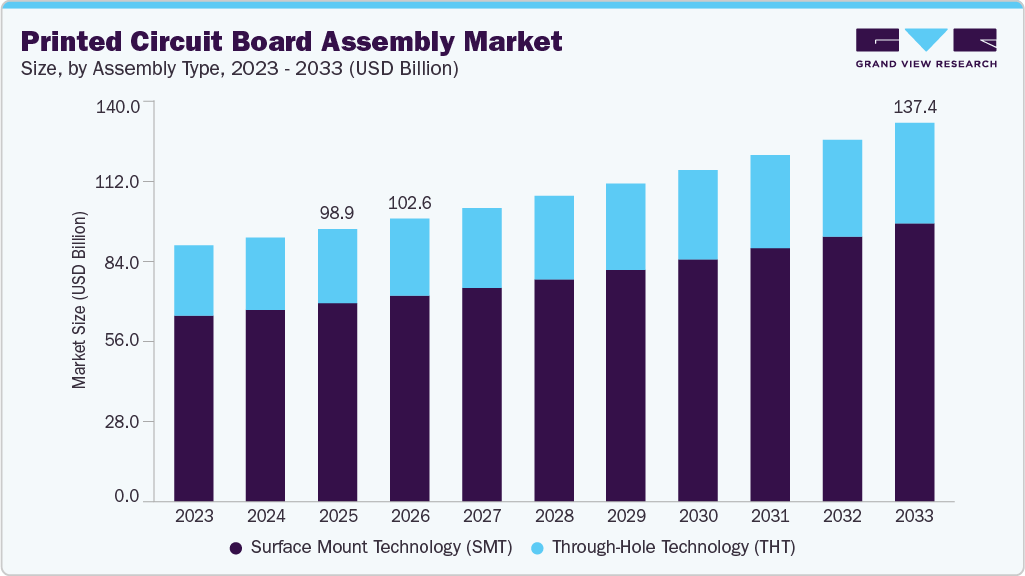
The global PCB (Printed Circuit Board) assembly market was estimated at $98.9 billion in 2025 and projected to grow at a CAGR of 4.3% from 2026 to 2033 and will surpass $137 billion, according to Grand View Research.
However, the most interesting highlight is that the surface mount technology (SMT) led the market, holding a market share of over 72.7%.
What is SMT PCB Assembly?
SMT PCB assembly is a cutting-edge technology that replaces traditional methods. Instead of inserting components through drilled holes in the PCB, surface mount technology (SMT) mounts components directly onto the surface. The technology follows pre-defined instructions to precisely mount components, even the tiny ones, accurately.
5 Key Advantages of Using SMT (Surface Mount Technology)
Regardless of growing numbers, demand, and market dominance, surface mount technology benefits in many ways, making it a preferred method for manufacturers and businesses. Let’s explore some incredible advantages of SMT PCB assembly in electronics.
- 0
When it comes to crafting a smaller, lighter and more compact design, SMT PCB assembly becomes the first choice. It helps mount components even on smaller pads, maximizing available space. Surface-mount technology provides greater flexibility to create complex, multi-layer PCBs without being constrained by hole locations.
- Automated and Accelerated Production
An automated manufacturing process is one of the biggest advantages of SMT PCB assembly. It’s highly compatible with automated manufacturing, which is crucial for accelerated electronics production. Using SMT in PCB assembly, thousands of components can be produced in an hour.
Especially for manufacturers and businesses seeking large-scale production, SMT technology can meet demand. It reduces production time and contributes to mass production.
- Improved Performance and Reliability
Another key benefit of Surface Mount Technology is enhanced electrical performance and long-term reliability. Components mounted using MST ensure faster signal transmission and lead to enhanced performance. Moreover, several SMT packages dissipate heat more efficiently, contributing to the increased lifespan of electronic devices.
- Cost-Effective Manufacturing
SMT significantly reduces costs compared to traditional through-hole technology. It accelerates production, reduces material usage, lowers costs associated with manual efforts, and more.
Ultimately, electronic PCB soldering reduces overall costs and helps keep pricing competitive.
Moreover, increased accuracy and precise mounting also minimize the expenses that demand efforts in fixing unexpected issues when applying traditional methods.
- Maximize Space for Multi-Layer PCBs
By accepting the reality that modern electronics often rely on multi-layer PCBs with dense routing and complex interconnections. SMT electronic PCB assembly is ideal for this type of design.
It frees up space via precise soldering, utilizes inner layers of a multi-layer board and allows components to be placed on both sides of the board without drilling through-holes.
Steiner Elektronik: Your Reliable SMT PCB Assembly Partner
Looking for a reliable partner for SMT PCB soldering services?
Stop your searching! Partner with Steiner Elektronik, a trusted partner in electronic manufacturing. Serving the industry since 1969, we offer end-to-end services for partial or complete SMT electronic PCB assembly. With a strong focus on quality, flexibility and long‑term relationships, Steiner Elektronik supports you throughout the cycle.
Final Thought
In this blog, you have explored the advantages of using SMT PCB assembly in electronics. From greater design flexibility to improved electrical performance, faster and automated production, cost-efficiency and more. In short, the utilization of SMT PCB assembly can benefit you in many ways.
Therefore, whether you’re developing consumer gadgets, industrial controllers, or cutting-edge IoT solutions, adopting SMT ensures that high-quality PCB assembly can help you achieve better performance, reliability, and scalability in your products.
FAQS
1. What is SMT PCB assembly in simple terms?
SMT PCB assembly is a modern method of building electronic circuits where components, called surface‑mount devices (SMDs), are mounted directly onto the surface of a printed circuit board (PCB). Instead of inserting component leads into drilled holes.
2. How is SMT different from through-hole technology?
In through‑hole technology, components are inserted into holes drilled and soldered on the opposite side. In Surface Mount Technology (SMT), components are placed directly on the surface of the PCB and soldered to flat pads.
3. What industries benefit the most from SMT PCB assembly?
SMT PCB assembly is used across several industries such as consumer electronics, automotive, telecom, networking, healthcare, and others.